
Starting Your Journey with Compassion
Beginning your journey with TMS therapy can feel overwhelming. If you’ve been living with major depressive disorder (MDD) or treatment-resistant depression, you may already feel exhausted from trying different antidepressants, psychotherapy, or other treatment options without lasting relief.
At Sunrise Psychiatry, we understand how heavy that can feel.
Improving your mental health doesn’t have to be confusing or intimidating. Our compassionate team is here to guide you every step of the way as you explore whether TMS could be the right next step in your treatment plan. You are not alone—and there are still effective options available.
Understanding TMS Therapy: Simple Science, Real Relief
Transcranial Magnetic Stimulation (TMS) is an FDA-approved, non-invasive form of neuromodulation used in psychiatry to treat major depressive disorder and other mental health conditions such as anxiety and OCD.
TMS works by delivering magnetic pulses through a TMS coil placed on your scalp. These pulses stimulate specific brain regions, particularly the prefrontal cortex, which plays a key role in mood regulation and executive function. In people with depression, this area can be underactive. By using targeted magnetic fields, TMS helps “wake up” those circuits and promote healthier brain activity.
TMS is very different from older treatments like electroconvulsive therapy (ECT). It does not require anesthesia, does not cause memory loss, and is performed while you are awake and alert. Repetitive TMS (rTMS) has been extensively studied in clinical trials and is FDA-approved for the treatment of major depressive disorder, OCD, and other psychiatric and neurologic conditions.
For many patients who have not found relief with antidepressant medications, TMS offers new hope.
Your First Appointment: Personalized Care from the Start
Your experience begins with a free 20-minute consultation call with one of our knowledgeable TMS coordinators. This is a no-pressure opportunity to ask questions and learn more about TMS treatment.
If you choose to move forward, you’ll meet with our healthcare provider, Dr. Sonni Elliott, for a comprehensive evaluation. During this visit, you’ll review:
- Your medical and psychiatric history
- Your experience with antidepressants
- Previous psychotherapy or other treatment modalities
- Any current mental health symptoms
- Relevant medical conditions
This evaluation helps determine whether TMS is appropriate for you. TMS is commonly used for major depressive disorder (MDD), treatment-resistant depression, OCD, and sometimes GAD, depending on your individual case.
Our goal is simple: to understand your unique journey and build a treatment plan that makes sense for you.
A Look Inside a TMS Session: Comfort, Calm, and Care
One of the most common questions we hear is: “What does a TMS session actually feel like?”
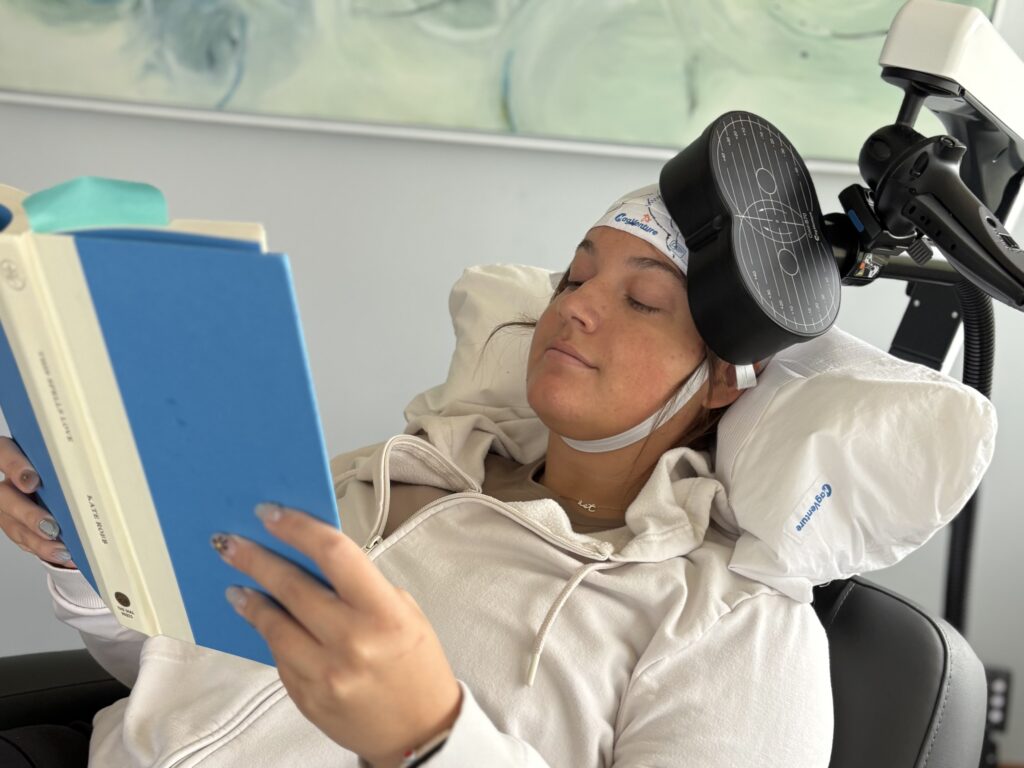
Each TMS treatment session is administered by one of our certified technicians in a calm, comfortable setting. You’ll sit in a reclining chair while we position the magnetic coil on your head. Before starting treatment, we determine your “motor threshold,” which helps us personalize the intensity of the magnetic pulses to your brain.
During treatment, you’ll hear a clicking sound and feel a tapping sensation on your scalp—many patients describe it as similar to someone gently tapping a pen against your head. While the sensation may feel unusual at first, it should not be painful.
To keep you comfortable, we offer:
- Earplugs
- Mouth guards (if jaw tension occurs)
- TV, music, or podcasts during treatment
Each session lasts less than 30 minutes. One of the major benefits of TMS therapy is that there’s no downtime—you can drive yourself home and return to work or daily activities immediately afterward.
Side Effects of TMS: What You Might Feel (and What You Won’t)
TMS is considered low-risk and well-tolerated.
The most common side effects include:
- Mild scalp tenderness
- Temporary headaches
- Light fatigue
These symptoms are typically mild and often improve after the first week of treatment.
Unlike ECT, TMS does not require anesthesia and does not cause memory loss. Serious side effects are rare, but it’s important to inform your healthcare provider if you have:
- A history of seizures
- Metal implants in or near the head
- A history of brain injury
Transparency helps us ensure your safety and determine whether TMS is the right fit.
If you’re curious whether you might qualify, visit our self-assessment at sunrisepsychkc.com to explore your candidacy.
Your TMS Treatment Plan
A typical TMS treatment plan involves:
- 5 sessions per week
- For approximately 7-9 weeks
That usually means around 36 treatment sessions total, with the last few weeks being a titration period.
Consistency is important for optimal results, but scheduling is flexible. Many patients come in before or after work, making it easier to maintain their normal routine.
Throughout your treatment of depression or OCD, you’ll have follow-up visits with your healthcare provider to monitor progress and make any needed adjustments. Some patients begin noticing improvements within a few weeks, while others see gradual changes over time.
After completing the initial course, some individuals benefit from occasional maintenance sessions, especially if they have a history of recurrent major depression. We’ll work with you to determine what ongoing care, if any, makes sense for your long-term mental health.
Sunrise Psychiatry: A Supportive Space for Healing
At Sunrise Psychiatry in Overland Park, serving the greater Kansas City area, we believe healing happens best in a space that feels safe, warm, and supportive.
Our clinicians and technicians combine evidence-based psychiatry with genuine compassion. We take time to listen, to answer questions, and to understand the full picture of your experience with major depressive disorder, OCD, or other mental health challenges.
TMS therapy is not just a procedure to us; it’s part of a larger commitment to providing thoughtful, science-backed care tailored to each individual.
You deserve to feel heard. You deserve options. And you deserve a treatment team that walks alongside you.
Ready to Take the Next Step? We’re Here to Help
If you’re feeling nervous, that’s completely normal. Many patients who begin TMS therapy once felt unsure, too—especially after struggling with treatment-resistant depression or ongoing depression symptoms despite trying multiple modalities.
Reaching out for help is brave.
TMS is FDA-approved, non-invasive, and offers hope for individuals who haven’t found relief with antidepressants or traditional psychotherapy alone. If you’re wondering whether TMS could be right for you, we invite you to schedule a free consultation with our team.
Your mental health matters. Healing is possible. And we’re here to help you take that next step with confidence.