
A New Way to Support Mental Health
If you’ve been navigating depression or other mental health challenges and feel like traditional treatments have not brought the relief you hoped for, you are not alone. For many people, antidepressants and psychotherapy are helpful. For others, symptoms linger despite their best efforts.
That is where TMS, or transcranial magnetic stimulation, offers a new path forward.
TMS therapy is a non-invasive, FDA-approved treatment used in psychiatry to support people with treatment-resistant depression and other mental health conditions. It works differently than medication. Instead of circulating through the entire body, TMS targets specific areas of the brain involved in mood regulation.
Since receiving FDA approval in 2008, transcranial magnetic stimulation has become increasingly accepted in mental health and psychiatry as a safe, effective, and evidence-based treatment option. It represents a hopeful step forward in how we understand and treat depression.
What Exactly Is TMS?
- At its core, TMS is a form of brain stimulation that uses a magnetic field to activate specific nerve cells in the brain.
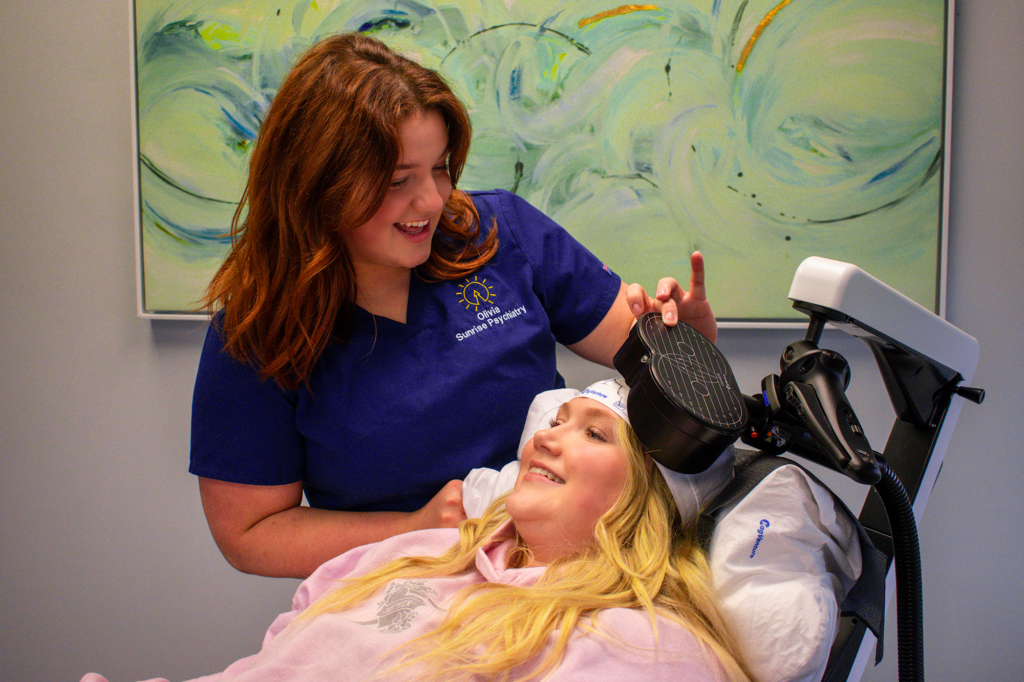
During treatment, a magnetic coil is placed gently against the scalp. This magnetic coil delivers focused magnetic pulses to a targeted area of the brain. These pulses pass painlessly through the skull and stimulate neurons, or nerve cells, in regions associated with mood.
Importantly, TMS is not electroconvulsive therapy (ECT).
There is:- No sedation
- No electrical current flowing through the brain
- No memory loss
- Instead, TMS uses magnetic stimulation to safely activate brain cells. Patients remain fully awake and alert throughout the session.
You will hear a rhythmic clicking sound during treatment as the device delivers pulses. This clicking sound is completely normal and simply reflects the magnetic pulses being administered. Earplugs are provided to protect your hearing and make the auditory experience more comfortable.
By stimulating targeted areas of the brain, TMS therapy helps improve activity in regions that may be underactive in depression and other mental health conditions.
The Science Behind the Relief
To understand the effects of TMS, it helps to look at one key brain region: the prefrontal cortex.
The prefrontal cortex plays a major role in emotion regulation, decision-making, motivation, and focus. In individuals with major depressive disorder, this area of the brain often shows decreased activity and reduced connectivity with other brain regions.
TMS stimulates the prefrontal cortex using carefully calibrated magnetic pulses. Over time, this stimulation:
- Improves communication between neurons
- Enhances connectivity across important brain regions
- Supports healthier patterns of brain activity
- Promotes changes in neurotransmitter function
Clinical trials and ongoing research in neurology and psychiatry have demonstrated that TMS can significantly reduce symptoms of major depressive disorder, OCD, and other mental health conditions. The results are not just theoretical. They are backed by years of scientific study and FDA review.
For many patients, these changes translate into improved mood, increased motivation, better concentration, and renewed engagement with daily life.
Types of TMS We Offer at Sunrise Psychiatry
At Sunrise Psychiatry, we provide two evidence-based types of TMS:
Repetitive TMS (rTMS)
Repetitive TMS, or rTMS, delivers a series of magnetic pulses in a consistent pattern. Each TMS session typically lasts around 20 to 40 minutes, depending on the protocol. Treatment sessions are usually scheduled five days per week for several weeks.
Theta Burst Stimulation
Theta burst stimulation is a newer, efficient form of TMS therapy that delivers magnetic pulses in shorter bursts. This allows for significantly shorter TMS treatment sessions, often around 3 to 10 minutes, while maintaining effectiveness.
We do not offer deep TMS at our medical center. Current research has not demonstrated superior evidence compared to other forms of TMS, and we prioritize treatments supported by the strongest available data.
Every TMS treatment plan at Sunrise Psychiatry is personalized. Before starting, we complete a thorough evaluation to determine the most appropriate protocol based on your symptoms, history, and goals. Our approach is rooted in evidence-based psychiatry and compassionate care.
What Does It Feel Like?
One of the most common questions we hear is, “What does a TMS session actually feel like?”
Most patients describe a “woodpecker” or a “pen-tapping” sensation on the scalp where the TMS coil rests. This tapping corresponds to the magnetic pulses stimulating the area of the brain being treated. Some mild scalp discomfort can occur at the beginning, but it often dissipates after the first few sessions as your body adjusts.
You remain awake and alert the entire time.
At Sunrise Psychiatry, we strive to create a comfortable environment. Many patients choose to watch TV, listen to music, or play a podcast during treatment. Once your session ends, you can immediately return to daily activities, including work, school, or driving.
There is no downtime, and no recovery period required.
Safety, Side Effects & What to Know
It is completely normal to have questions about safety.
TMS is FDA-approved and considered a safe form of neuromodulation when delivered by trained providers. The most common side effects are mild and temporary, including:
- Mild scalp discomfort
- Occasional headache
These side effects, if experienced, typically improve early on in the treatment course.
The risk of seizures is extremely low and comparable to many commonly prescribed medications. Before beginning TMS therapy, our providers conduct a detailed screening to ensure safety. We carefully review medical history, including any metal implants or prior seizure history, to determine if TMS is appropriate.
Unlike electroconvulsive therapy, TMS does not cause memory loss and does not require anesthesia. It is a localized, outpatient treatment designed with safety and precision in mind.
Who Is a Good Candidate for TMS?
TMS treatment is especially helpful for individuals with treatment-resistant depression, meaning they have not experienced adequate relief from at least one antidepressant or psychotherapy.
You may be a strong candidate if you:
- Have tried antidepressants without sufficient improvement
- Experienced unwanted side effects from medication
- Prefer a non-medication treatment option
- Struggle with major depressive disorder or OCD
A provider at our medical center will conduct a full evaluation to screen for contraindications and determine whether TMS therapy is a safe and effective choice for you.
If you are unsure, that is okay. The first step is simply a conversation
Your Brain. Your Journey. A New Option.
TMS therapy represents a powerful shift in mental health care. It is science-backed, FDA-approved, and designed to target specific areas of the brain involved in mood regulation.
For many individuals, TMS treatment leads to meaningful improvement in depression, OCD, and other mental health conditions. It is not a last resort- it is a forward-thinking, evidence-based option within modern psychiatry.
Your brain is adaptable. Change is possible.
If you are curious whether transcranial magnetic stimulation might be right for you, we invite you to schedule a free consultation with our team at Sunrise Psychiatry. Together, we can explore your options and determine the next best step in your mental health journey.