
If you’ve been trying to manage depression or anxiety for a while, you already know how overwhelming it can feel to find the “right” treatment. Many people start with antidepressant medications because it’s often the first recommendation from a doctor to improve their well-being. For some, medication helps and could help for a while. But for others, the relief never fully arrives, or the side effects become too difficult to live with.
And when you’re still feeling unwell after doing everything you’re “supposed” to do, it can feel exhausting, discouraging, and deeply personal.
It’s okay to feel that way.
There are multiple treatment options for depression, and your path does not have to look like anyone else’s. Alongside medication and therapy, there is also a non-invasive, FDA-approved treatment called Transcranial Magnetic Stimulation (TMS) that has helped many people who haven’t gotten relief from medication alone.
Let’s break down how antidepressants and TMS work, how they differ, and how to know which option might be right for your mental health journey.
How Antidepressant Medication Works (and Its Limitations)
Antidepressants like SSRIs and SNRIs are often the first step in treating depression. These medications work by helping balance neurotransmitters (such as serotonin, dopamine, and norepinephrine) that play a role in mood regulation.
For many people, antidepressants can:
- Take the edge off depressive symptoms
- Improve sleep or appetite
- Create enough emotional relief to engage in therapy or daily tasks
However, medication affects the entire body, not just the part of the brain involved in mood. Because of this, side effects are common and may include:
- Sexual dysfunction
- Weight gain
- Fatigue or low energy
- Sleep changes
- Lightheadedness
- Emotional numbness or blunting
Some people also feel frustrated by the need to stay on medication long-term to maintain benefits. And for those with treatment-resistant depression or OCD, medication alone may not provide enough relief.
This doesn’t mean medication is “bad” or ineffective. For many people, it is an important part of a comprehensive treatment plan, especially when combined with therapy. But it is not the only option you have.
What Is TMS Therapy? A Closer Look
TMS stands for Transcranial Magnetic Stimulation. It is an FDA-approved, non-invasive treatment for depression and certain anxiety-related conditions such as OCD.
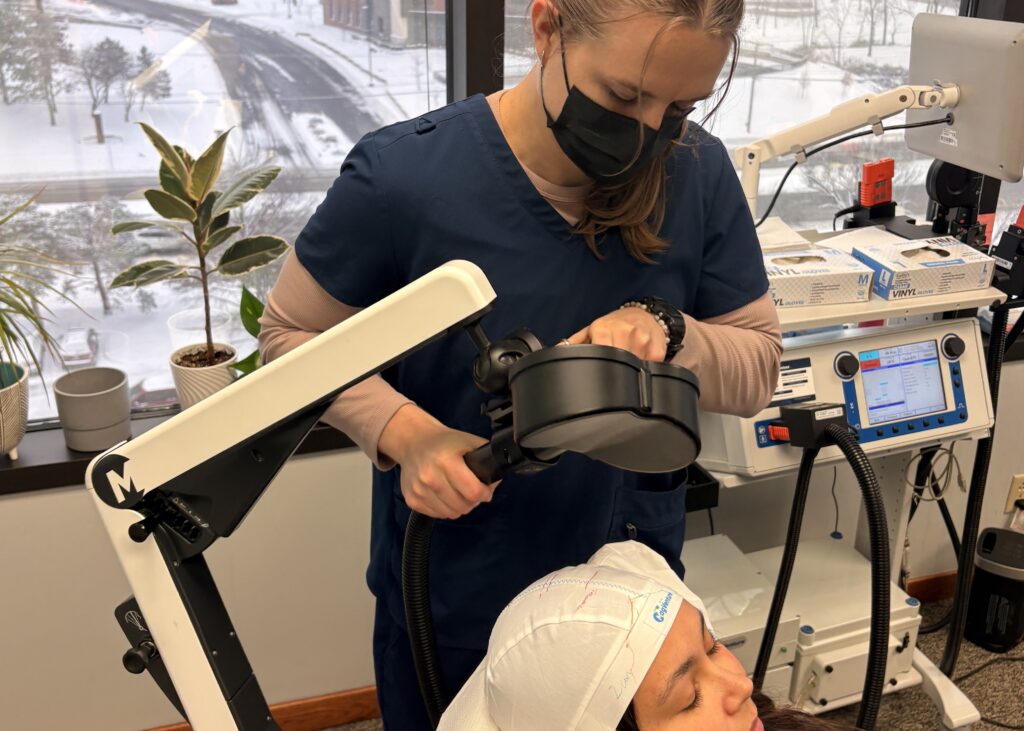
Instead of affecting the whole body, TMS treatment sessions target a specific area of the brain involved in mood regulation: the prefrontal cortex. During treatment, a small magnetic coil is placed gently against the scalp. This coil delivers focused magnetic pulses that stimulate underactive neural pathways, helping restore healthier brain activity.
Most patients describe the sensation as a gentle tapping or tingling on the scalp, directly beneath the treatment coil. You may hear rhythmic clicks as the magnetic pulses are delivered.
Each session lasts 3 to 30 minutes, depending on your personalized protocol. During that time, you’re free to watch TV, listen to music, rest your eyes, or simply relax.
What to expect:
- No sedation or medication needed
- You are awake and seated comfortably during treatment
- Sessions last about 20–30 minutes
- Typically occurs daily for 6 to 9 weeks.
- No downtime afterward (you can drive yourself to and from appointments)
TMS side effects are usually minimal and short-lived, often limited to temporary scalp sensitivity or a mild headache early in the treatment course. Many patients, however, never experience side effects at all.
Many patients experience long-lasting improvement, even after treatments end. In fact, TMS has been shown to provide more sustained remission for some individuals compared to medication alone.
TMS vs. Antidepressants: Side-by-Side Comparison
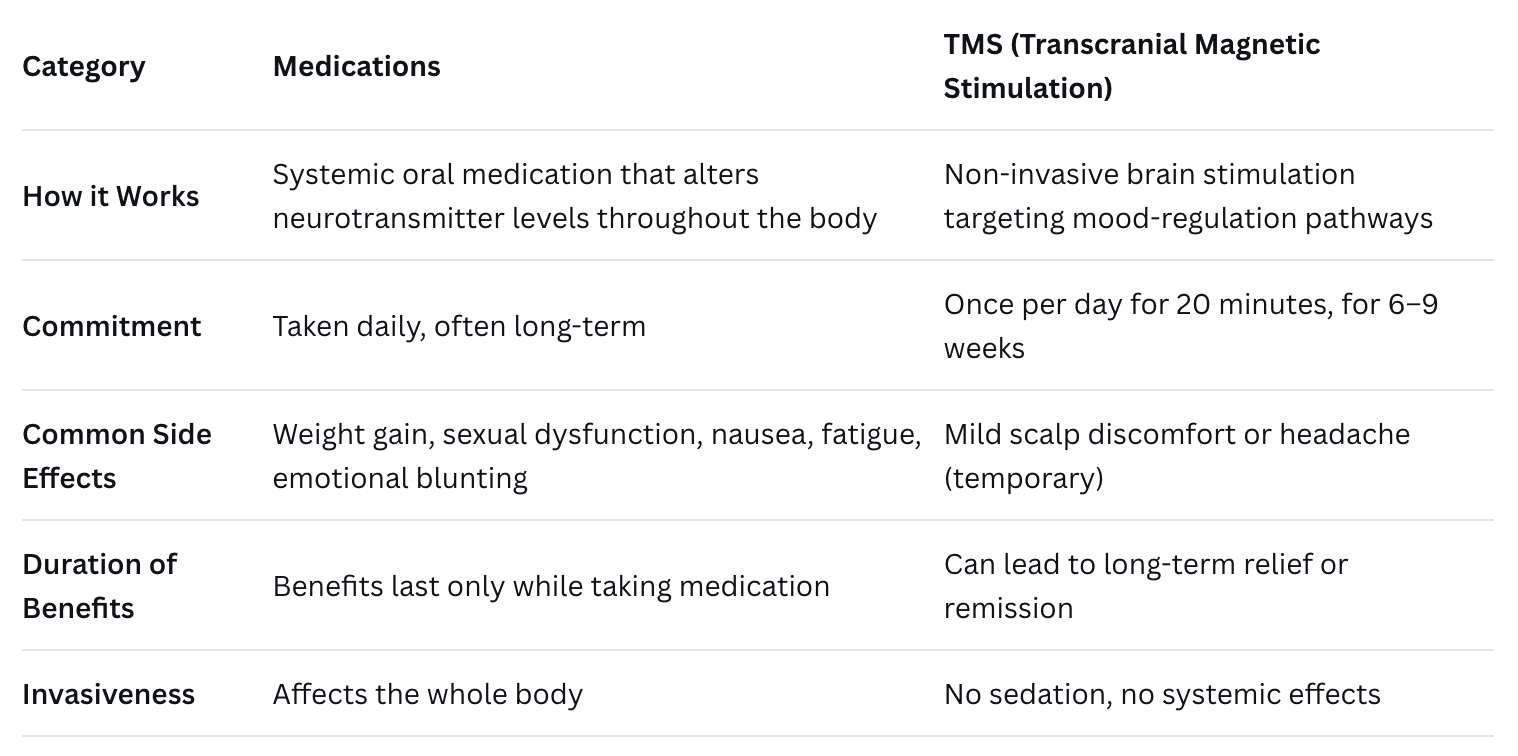
When you’re trying to decide between antidepressants and TMS therapy, it helps to look at the differences in how each treatment works, what the commitment looks like, and how they may affect your daily life. Both options are valid and evidence-based, but they support the brain in very different ways.
Antidepressants are taken orally and work throughout the entire body. For some people, they help rebalance brain chemicals and ease symptoms. But because the medication circulates systemically, side effects like weight gain, sexual dysfunction, nausea, fatigue, or emotional blunting can be common and difficult to manage.
TMS therapy, on the other hand, is non-invasive and targets a specific area of the brain involved in mood regulation. It’s delivered through in-office sessions using magnetic pulses, with no sedation or medication. Side effects are generally mild and temporary, usually limited to a light headache or scalp tenderness in the first few days.
Another key difference is the timeline. Antidepressants must be taken every day, often long-term, to maintain benefits. TMS is typically completed in a 6-9 week series of short daily sessions, and many patients experience long-lasting relief or even remission once treatment is complete.
Most insurance plans cover both antidepressants and TMS, especially when depression has not improved with medication alone.
Here’s a simple comparison to help you weigh each option:
Patient Story: A Life Changed by TMS
Sometimes the most powerful way to understand what TMS can offer is to hear from someone who has walked through the darkest parts of depression and finally found relief. One of our patients shared the following story, and it continues to resonate with so many people who feel stuck, exhausted, or hopeless in their mental health journey:
“I struggled with depression and anxiety since I was young and, most of the time, I was able to manage with medications. However, shortly after I gave birth to my son seven months ago, I was struck with severe postpartum depression and anxiety, and medications were only having a minimal effect.
On the highest doses, I still experienced despairing feelings, and debilitating anxiety. I tried TMS with an open mind and hoped these treatments would provide me some relief. I’m so glad I did. It has been life changing! I no longer feel depressed or ruminate. I’m able to be more present with my family, and I feel more hopeful.
After 25 years of being on medication, I am finally tapering off. After just 30 treatments of TMS, Dr. Elliott told me that I had reached remission – words I never thought I would hear from a doctor. TMS has truly been a game changer, and I am so grateful to Dr. Elliott and her team.”
— Anonymous
This story highlights several important and incredibly meaningful points:
- They had been on antidepressant medications for 25 years
- After giving birth, they developed severe postpartum depression and anxiety
- Even on the highest doses, medication alone wasn’t enough
- After 30 TMS sessions, they reached full remission
- For the first time in decades, they are finally tapering off medication
- Most importantly, they feel present, hopeful, and able to enjoy time with family again
For anyone who has been battling symptoms for years, these results can feel almost unbelievable. But they’re real. And they’re happening before our eyes for people who once thought they had run out of options.
If you’re reading this and wondering whether a different kind of relief is possible for you too, you’re not alone. TMS has helped many individuals with treatment-resistant depression, postpartum depression, and long-standing major depressive disorder reclaim their lives in ways they never imagined.
And you deserve the same chance at healing.
Is TMS Right for You? Questions to Consider
Choosing a mental health treatment is a big decision, and it’s completely normal to feel unsure about which direction to go. TMS isn’t the right fit for everyone, but it can be a powerful option for people who haven’t found relief with traditional approaches.
Here are a few questions that can help you think through whether TMS might be worth exploring:
- Have you tried multiple antidepressants with little or no improvement?
- Many people who benefit from TMS have cycled through several medications without the relief they hoped for.
- Do medication side effects affect your quality of life?
- Issues like weight gain, fatigue, sexual dysfunction, or emotional numbness can make it challenging to stay on a medication long-term.
- Are you looking for a treatment option that doesn’t involve medication?
- TMS is a non-medication-based approach that is especially helpful for people who can’t tolerate the systemic effects of antidepressants.
- Are you interested in a non-invasive, evidence-based therapy?
- TMS is FDA-approved, doesn’t require sedation, and is supported by strong clinical research for major depression, treatment-resistant depression, and OCD
Why Choose Sunrise Psychiatry for TMS Treatment?
Not all TMS providers are the same, and finding the right fit can significantly impact your overall experience and results. At Sunrise Psychiatry, we’ve built our TMS program to be more than just a treatment; it’s a place where patients feel seen, supported, and encouraged from start to finish.
Here’s why so many people in Overland Park and Kansas City choose us:
- Expert-led care – Every treatment plan is overseen by Dr. Sonni Elliott, a board-certified psychiatrist who specializes in TMS therapy and has years of experience guiding patients through individualized mental health journeys.
- Tailored treatment plans – No two patients are alike. We take time to understand your history, your goals, and what you’ve already tried. From there, we design a personalized treatment plan that meets your needs, whether it includes standard rTMS or advanced options like Theta Burst Stimulation.
- Cutting-edge technology – We use FDA-approved MagVenture devices, known for their accuracy, comfort, and strong clinical outcomes. This is the same technology trusted by leading research institutions across the country.
- Comfortable, calming environment – Our treatment rooms are designed with your relaxation in mind. Many patients pass the time listening to music, watching TV, or simply enjoying a quiet moment while treatment is delivered.
- Consistency and support – You’ll see the same friendly technician every day, creating familiarity and trust throughout your treatment course. Patients often tell us that those daily check-ins become one of their favorite parts of the process.
- Community connection – As a locally trusted practice in Overland Park, we’re proud to serve not only our neighborhood but the greater Kansas City area. Our patients know they’re part of a community that truly cares about their long-term wellness.
- Holistic focus – We don’t just treat symptoms. We coordinate care with your other providers, offer guidance on complementary therapies, and emphasize whole-person health, ensuring TMS becomes part of a bigger picture of recovery and growth.
What really sets us apart is our commitment to making TMS approachable. From your first consultation to your last session, we combine clinical expertise with genuine compassion, creating a treatment experience that’s not only effective but also uplifting. Patients often say they walk away not just with fewer symptoms, but with a renewed sense of hope and confidence in their future.
What Our Patients Say: Real Results, Real Relief
TMS and antidepressants are both valid treatment options, and each plays an important role in mental health care. But if medication hasn’t worked for you, or the side effects have become too difficult to manage, you deserve to know that there are other choices. TMS is a safe, effective, non-invasive therapy that is increasingly covered by insurance companies, especially for treatment-resistant depression.
Your healing journey doesn’t have to look like anyone else’s. What matters most is finding a treatment that actually helps you feel like yourself again.
If you’re curious about whether TMS therapy might be right for you, we’re here to support you. You can schedule a free phone consultation or complete a simple self-assessment on our website to learn more about your treatment options.
Contact Sunrise Psychiatry today to explore your next steps. You don’t have to keep struggling. Relief may be just a few sessions away.